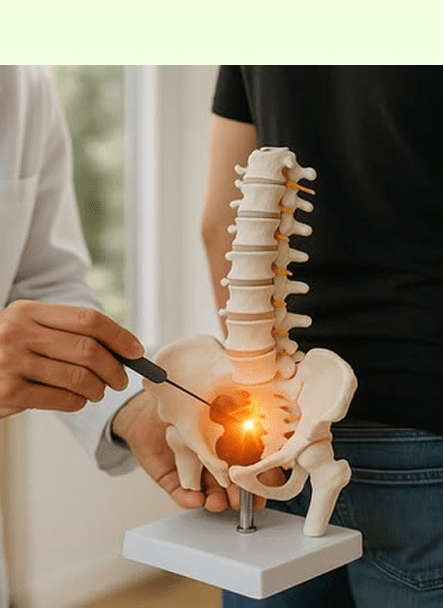
Structured, long-term physiotherapy for ankylosing spondylitis — maintaining spinal flexibility, reducing morning stiffness, slowing disease progression, and helping you stay active and independent throughout your treatment.
Designed to reduce pain, restore mobility, and improve your quality of life — with a programme built around your specific condition and recovery goals.
Daily mobility exercises targeting the thoracic, lumbar, and cervical spine maintain the flexibility that is most at risk in AS — preventing the progressive stiffness that leads to fusion.
A structured morning exercise routine — specifically designed for AS — mobilises the inflamed joints and reduces the characteristic morning stiffness within 20–30 minutes of waking.
Breathing exercises and thoracic mobility work maintain chest expansion — critically important in AS where rib joint inflammation can restrict breathing depth over time.
Spinal extension exercises, postural awareness training, and positioning advice prevent the forward-bent spinal posture that develops in poorly managed AS.
Physiotherapy significantly enhances the outcomes of your rheumatologist’s medication or biologic therapy — producing better functional results than medication alone.

Ankylosing spondylitis (AS) is a chronic inflammatory arthritis that primarily affects the spine and sacroiliac joints. The inflammation causes progressive stiffness and pain — characteristically worse in the morning and after periods of inactivity, but improving with movement and exercise. Over time, if inflammation is not managed, the vertebrae can fuse together (ankylosis) — reducing spinal mobility and potentially causing a fixed, forward-bent posture. AS disproportionately affects young men, typically presenting between ages 17 and 35, and requires lifelong management. Physiotherapy is the most critical non-pharmacological intervention for maintaining quality of life in AS.

Our physiotherapy programme for AS focuses on maintaining maximum spinal and chest expansion mobility, preventing abnormal posture through specific corrective exercises, building the muscular strength to support the spine, and designing a sustainable home exercise routine that patients can maintain between clinic sessions. We work alongside your rheumatologist's medication programme — physiotherapy and biologics together produce significantly better outcomes than either alone. Our programme is lifelong-compatible: structured to evolve with your condition's stage.
Management Approach
Quality of Life Maintained
Slower Progression with Physio
Every recovery journey is different. Here is what our patients say about their experience at New Age Rehab.
Posted on GoogleTrustindex verifies that the original source of the review is Google. I had my shoulder treatment at New Age Home Physio with Dr. Junaid, and the experience was excellent. He carefully assessed my condition and created a personalized treatment plan. I noticed significant improvement in my pain and movement within a few sessions. Highly professional and highly recommended! The sessions were well-structured and very comfortable, and he patiently explained every step of the therapy. I truly appreciate the care and dedication shown throughout my recovery process.Posted on GoogleTrustindex verifies that the original source of the review is Google. Dr Sharma's team is very helpful and courteous. Thank you for your efforts to trying to get me going.🙏Posted on GoogleTrustindex verifies that the original source of the review is Google. I had a very good treatment at New Age Physiotherapy Centre, Uday Park. Dr. Junaid Ansari is an excellent physiotherapist—highly knowledgeable, well-behaved, and very professional. He is extremely caring and attentive towards his patients and explains the treatment clearly. I felt comfortable and satisfied throughout my sessions. His approach to patient care is truly commendable. I would highly recommend this centre to anyone looking for quality physiotherapy treatment. I am very thankful to Dr. Rahul Sharma for suggesting the right treatment for me. His guidance was clear and reassuring, and the entire treatment process went very smoothly.I truly appreciate his support and care. My thanks to Dr. Anam & other staff.My sincere thanks to Dr Junaid who was my physiotherapy doctor. Thank you very much for your guidance & therapy.Posted on GoogleTrustindex verifies that the original source of the review is Google. The Physio clinic centre is an excellent centre . They attend very promptly. I am extremely satisfied with my progress especially after my lung cancer where Anam Siddiqui has been very professional in her work and helped me to recover . I am playing my tennis now . Cdr Ravi Inder singhPosted on GoogleTrustindex verifies that the original source of the review is Google. A lot of care! And it’s good to have a qualified and patient doctor around, Dr Rahul Sharma. His team is also good!Posted on GoogleTrustindex verifies that the original source of the review is Google. Had gone for a hamstring pull and issues with knees and Dr Junaid and Dr Rahul helped overcome them within days!Posted on GoogleTrustindex verifies that the original source of the review is Google. Mr Junaid Ansari one of the best professional and work oriented person from this clinic. I took session from him and now can walk and move easily. He has the very good knowledge of each ligaments and doing treatment by physi accordingly. Now I am able to do walk and inflammation has been reduced. Thankyou for the guidance and therapy.
Have questions about Ankylosing Spondylitis treatment? Here are the most common queries — to help you understand what to expect and how physiotherapy can help.
Physiotherapy cannot stop the underlying inflammatory process — that requires medical management. However, regular, structured physiotherapy significantly slows the functional decline caused by AS — maintaining spinal mobility, posture, and physical capacity at a substantially higher level than medication alone.
Regular daily home exercises are the foundation — typically 20–30 minutes every morning. Supervised physiotherapy sessions — every 1–2 weeks during active treatment — provide progression, assessment, and programme adjustment. Long-term maintenance sessions every 4–6 weeks are valuable for ongoing management.
Yes. Exercise is one of the most important interventions in AS — even during flares, gentle mobility exercises are recommended. Your physiotherapist will differentiate between exercises that help versus those to avoid during high-inflammation periods.
Swimming and hydrotherapy are excellent for AS — the warm water provides joint pain relief while allowing full spinal mobility work. We incorporate hydrotherapy guidance into our AS rehabilitation programmes.
Yes. AS can affect hips, knees, shoulders, and ankles — as well as the eyes (uveitis), heart, and lungs in severe cases. Our physiotherapy programme addresses the full body impact of AS, not just the spine.
Both. Rheumatology manages the underlying inflammation with medication. Physiotherapy manages the functional impact — maintaining mobility, posture, and physical capacity. The combination produces significantly better outcomes than either alone. We coordinate with your rheumatologist’s treatment plan.
Discover treatments that support your recovery and improve overall movement and function.
Select Your Nearest Centre
No surgery needed. 94.2% of our patients recover with a plan built just for them.
Select Your Nearest Centre